Greater Omentum Flap
Anatomic considerations
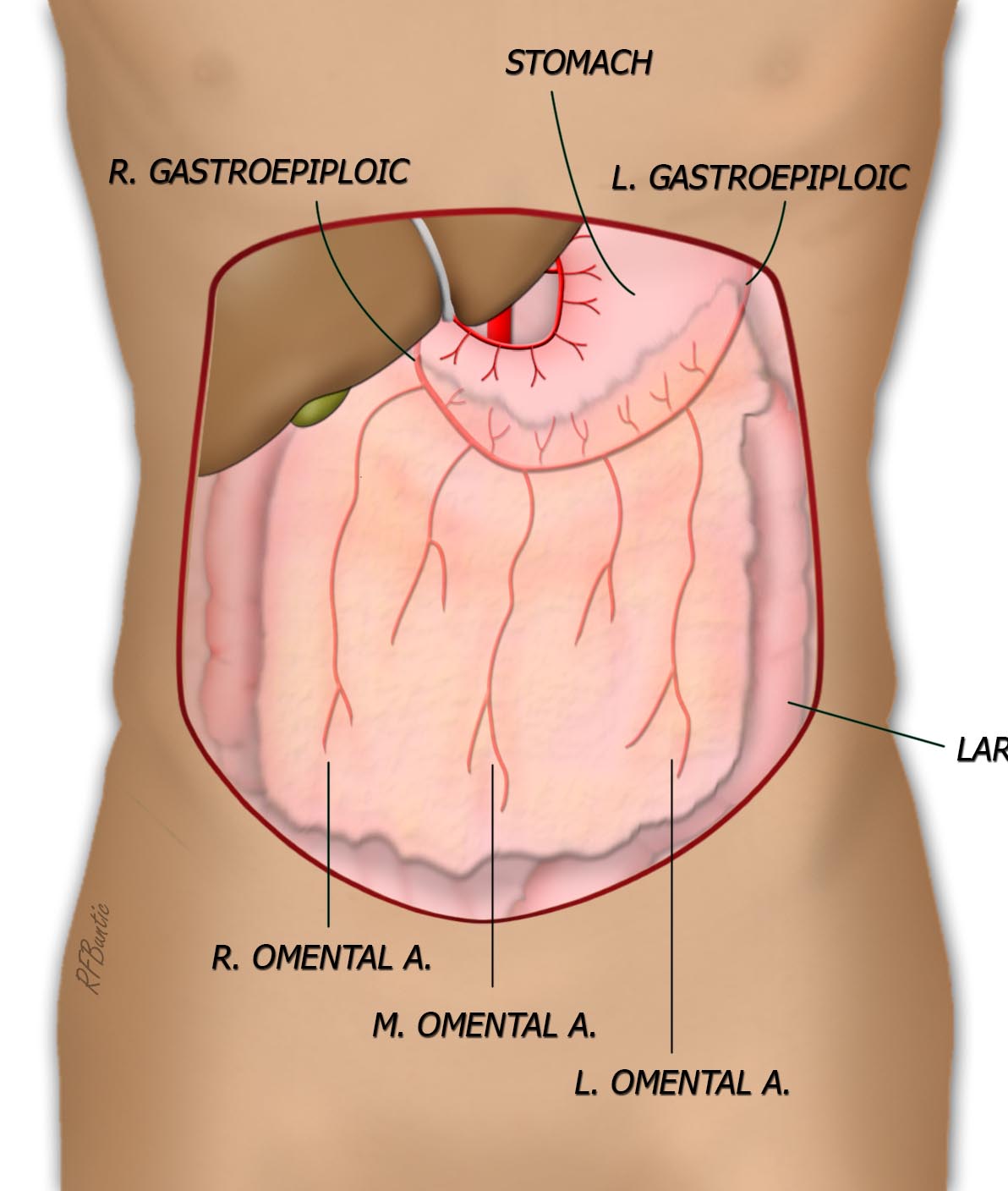
In 1972 Harry Buncke and Donald McLean published results of the first successful clinical microsurgical transplant. They used the greater omentum to cover a large scalp defect with exposed cranial bone resulting from a post-traumatic defect. This achievement was built upon laboratory research in microsurgery, using one of the first operating diploscopes in the United States, and microsurgical suture that was created by directly bonding nylon on a handmade needle.
The greater omentum is a large peritoneal fold consisting of connective tissue, fat and lymphatics. It is well vascularized with large feeding arteries and draining veins. Because harvesting requires laparotomy, this flap is used infrequently. Previous abdominal surgery may render the omentum scarred and adherent to the intra-abdominal contents, and therefore preclude its use.
Vascular Anatomy
The omentum possesses a rich arterial arcade with three dominant vessels descending from the gastroepiploic artery, along the greater curvature of the stomach. A right, middle and left omental branch arise from gastroepiplic system, with smaller intervening branches and adjacent draining veins. The flap is isolated on the right omental artery and the right gastroepiploic artery.
The greater omentum is supplied by three main arterial branches: the right, middle and left omental arteries. These take origin from the gastroepiploics.