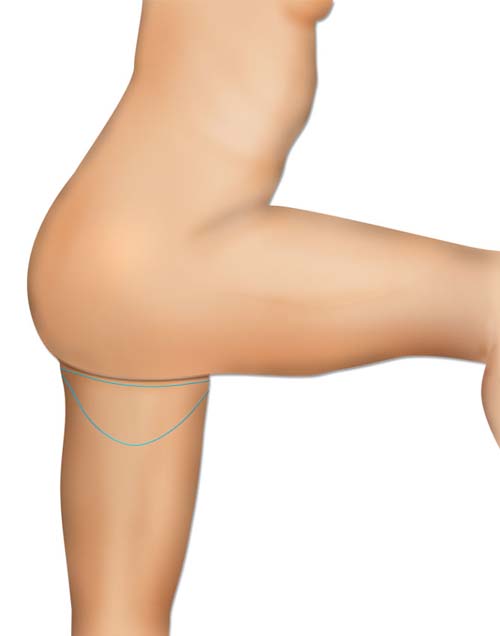
A skin, fat and muscle flap. The skin paddle can be from 11 cm wide and up to 25 cm long.
Innervation: Branch from the obturator nerve to gracilis is not used unless a functional muscle transplant is needed.
Blood supply: Gracilis vessels from the medial femoral circumflex system.
Artery: Usually small caliber, from 1 to 2 mm.
Vein(s): Two venae, one usually slightly larger than the artery.
Pedicle length: 6 to 8 cm long.
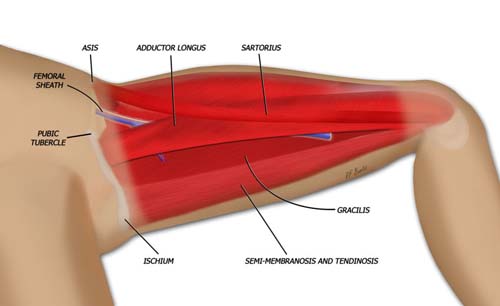
The cutaneous perforators of the gracilis muscle supply both the anterior and posterior inner thigh skin reliably. The tranverse orientation of the flap allows for a large skin paddle, with some independence from the muscle below. A medial thigh muscle, the gracilis takes origin off the pubic symphysis, inferior pubic ramus and ischium then inserts distally into the medial condyle of the knee. The axis of the muscle can be defined by drawing a line from the ischium to the medial condoyle of the knee. Or alternatively, the adductor longus is palpated medially with the thigh abducted, and the gracilis axis is defined 2 to 3 fingerbreadths posterior to the adductor longus.
The skin paddle of the flap is marked transversely, with the widest point centered over the gracilis muscle. Care must be taken not to resect too much skin, since closure can be difficult.
The patient is placed in the supine position with the legs abducted and the knees bent. The anterior flap is elevated first.
The flap is elevated superficial to the muscular fascia, preserving or ligating the saphenous vein as necessary for flap harvest.
When the edge of the adductor longus medial aspect is reached, the muscular fascia is incised and the pedicle to the gracilis is identified under the adductor longus. When the pedicle is identified, the posterior flap can be elevated.
After the posterior flap is elevated, the proximal and distal muscle can be divided. The pediicle is traced to it's origin to gain length as necessary.
Closure of the would is done in layers over suction drains.